"These apparently motiveless crimes are always the worst," said the inspector dolefully.
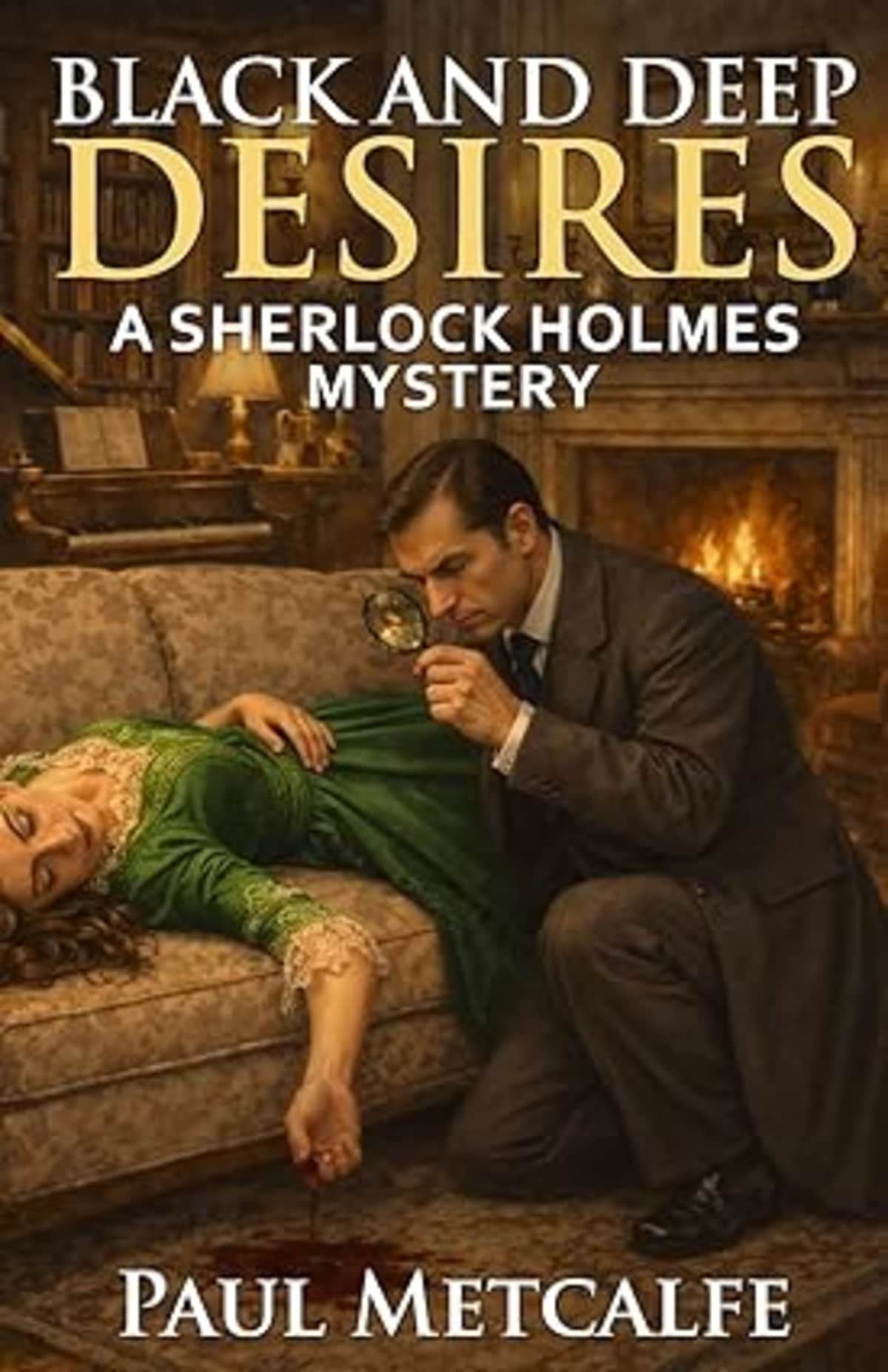
Charity Buntington's husband describes his wife as the most lovely and inoffensive person, whom nobody would want to hurt. But someone enters their home in broad daylight, strangles her, then cuts off and takes away her right forefinger. Inspector Hopkins asks Sherlock Holmes to help him investigate the case, but Charity's friend Aurora Jones is also a private detective, and wishes to help bring her friend's murderer to justice. Holmes is impressed with Jones' skills, and although Hopkins is reluctant, he agrees to let Miss Jones assist in the case under Holmes' guidance.
A few days later, another woman is killed in exactly the same fashion. And then another. The press is in a frenzy. Holmes believes there is a pattern to the killings, but what it is no-one can determine. Slowly the clues accumulate, but so do the bodies. With Holmes leading the investigation, he, Dr. Watson, Inspector Hopkins and Aurora Jones all work together to discover the killer's identity, but can they solve the mystery before another woman loses her life?” (Amazon)
Paul Metcalfe’s “Black and Deep Desires: A Sherlock Holmes Mystery” takes us on a psychological journey of murder and mutilation. Inspector Hopkins calls on Holmes and Watson to aid in his investigation when the first victim is discovered.
At the scene of the first murder, we meet Miss Aurora Jones who is a personal friend of the victim and a private detective establishing her own firm. Holmes finds her a competent, young detective with good observational skills and agrees to include her in the investigation under his tutelage.
Unfortunately, the bodies, and mutilations, continue to pile up. We get snippets from the mind of the killer after each murder. The clues are subtle and prove challenging, but Holmes, Watson and Jones prove to be up to the task.
Metcalfe’s Holmes, Watson and Inspector Hopkins are true to the original characters. Miss Jones provides a window onto the limitations and societal restrictions women faced at the time. But her tenacity and forthrightness help her to work around, and at times break through, those restrictions. Metcalfe treats those issues even-handedly and matter-of-factly without the lectures some authors feel compelled to inflict on readers who are just looking for a good story.
This is Metcalfe’s first novel following last year’s publication of his collection of eight Sherlock Holmes short stories titled “The Case of the Australian Atlases and other Sherlock Holmes Adventures.” I enjoyed this novel very much. I hope Mr. Metcalfe finds future cases that permit Miss Jones to again collaborate with Holmes and Watson.